A common estimate of Robert Kiyosaki’s net worth is $100 million, which is repeated in the finance media and referenced by websites such as Celebrity Net Worth. The number is clear. Round. Content. For someone who made a living by telling people that money is messy, it’s almost suspiciously tidy.
Kiyosaki was born in 1947 in Hilo, Hawaii, and his early years seem almost cinematic. Before turning to business, he was a helicopter gunship pilot in Vietnam, according to Wikipedia. That is an important detail. When he discusses risk, it gives it more weight. A person’s perception of danger is often recalibrated by war. It’s possible, however, that the mythology surrounding his “Rich Dad” story has expanded beyond the verifiable facts.
| Category | Details |
|---|---|
| Full Name | Robert Toru Kiyosaki |
| Born | April 8, 1947 |
| Birthplace | Hilo, Hawaii, U.S. |
| Profession | Author, Investor, Entrepreneur |
| Famous For | Rich Dad Poor Dad |
| Company | Rich Dad Company |
| Military Service | U.S. Marine Corps (Vietnam War helicopter pilot) |
| Estimated Net Worth | Around $100 million (widely reported) |
| Notable Claim | Has stated he holds over $1 billion in debt |
| Official Website | https://www.richdad.com |
| Reference | https://en.wikipedia.org/wiki/Robert_Kiyosaki |
His book Rich Dad Poor Dad, which sold millions of copies worldwide, was his big hit in 1997. The purple cover became a common sight in suburban living rooms and airport bookstores. The idea was straightforward: liabilities take money out of your pocket, while assets put it in. The accessibility of the language, which was nearly conversational, translated into royalties that were consistent, worldwide, and recurrent.
You could sense the energy when you walked into a financial seminar in the early 2000s, the kind that took place in hotel ballrooms with patterned carpets and lukewarm coffee. Participants taking notes. speakers who mention passive income. Kiyosaki’s name was all over the place, with promotional banners flanking the stage and books piled at the back. He seemed to understand the value of condensing financial anxiety into easily understood lessons.
His financial story isn’t simple, though.
One of his businesses, Rich Global LLC, declared bankruptcy in 2012. The headlines were incisive. The critics jumped in. How does a man who advocates for sound financial practices wind up in court? A corporate structure that absorbs liabilities is strategic, according to Kiyosaki. It’s still unclear if the typical reader can tell the difference between corporate bankruptcy and personal net worth. Often, the subtlety is obscured by the noise.
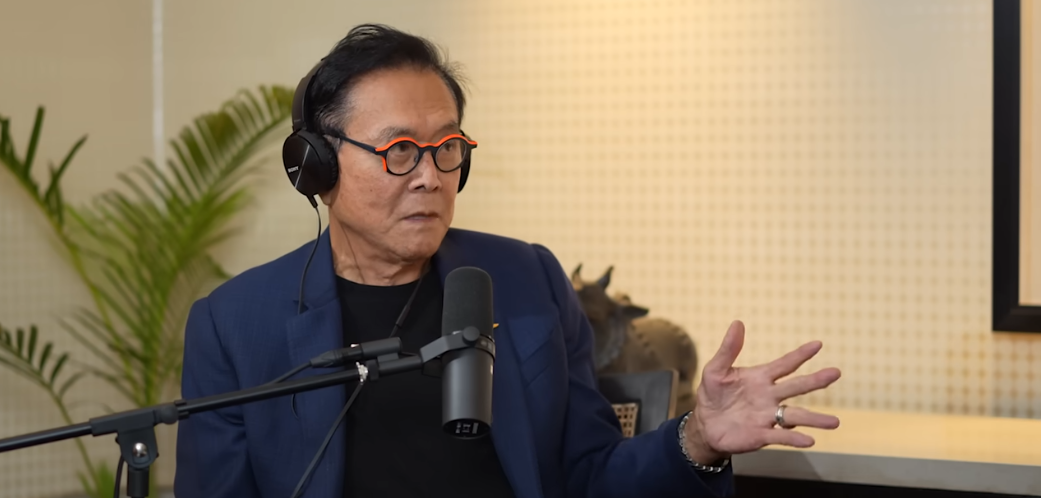
Kiyosaki has acknowledged in public that he has more than $1 billion in debt, characterizing it as “good debt” that he uses to buy assets that generate cash flow. There is a mixture of confidence and provocation when you watch interviews where he explains this while leaning forward a little and highlighting leverage. Leverage is perceived by critics as a gamble disguised as doctrine, while investors appear to view it as a tool.
He has long promoted purchasing gold, silver, and more recently, Bitcoin, which he refers to as “God’s money.” He proposed in 2025 that someone could become wealthy in a matter of years simply by owning 0.01 Bitcoin. It’s audacious. It’s conjectural. It’s really true to the brand. It seems as though Kiyosaki does best during uncertain economic times, posing as a mentor through impending crashes.
His wealth seems to be well-rounded. Book royalties are still coming in. The Rich Dad Company makes franchise money by licensing seminars all over the world. Board games, online courses, and educational products all contribute to the income stack. $100 million might not seem like much in comparison to the founders of Silicon Valley or the titans of hedge funds. However, it’s intimidating for a financial educator.
It’s difficult to ignore how divisive he has grown. Dave Ramsey and other traditional financial experts completely condemn debt, claiming that leverage is a trap. According to Kiyosaki, debt is a ladder when used responsibly. It feels more like ideology than accounting to watch this argument develop over time.
In recent years, his net worth was said to have been around $100 million, with some estimates slightly higher. Growth, indeed. However, it’s not explosive. That’s intriguing in and of itself. Instead of experiencing rapid financial growth, a man who teaches exponential wealth accumulation has witnessed steady growth. It’s possible that this consistency is deliberate, emphasizing cash flow over headline valuation.
There is a cultural impact that goes beyond the statistics. The beliefs of a whole generation regarding education, work, and investing were shaped by Rich Dad Poor Dad. It promoted skepticism about conventional career paths. It’s up for debate whether that advice encouraged readers or led some people astray. His seminars have been closely examined by the Canadian Broadcasting Corporation and other media. The influence of controversy trails.
Decades after his initial publication, his titles are still prominently displayed in bookstores today. That perseverance speaks volumes. Gurus of finance come and go. Kiyosaki perseveres, modifying his rhetoric in response to housing cycles, gold rallies, and cryptocurrency booms.
According to most reports, Robert Kiyosaki’s net worth of $100 million is more a reflection of narrative power than a fixed amount. It is based on both attention and assets. based on conviction. selling the notion that the laws of money are not the same as what we were being taught.
It might depend on markets we cannot yet predict whether his leverage-heavy approach proves to be stable or unstable. For now, though, the author who once questioned the worth of formal education has made a fortune by teaching others to think critically about the system, even with debt.