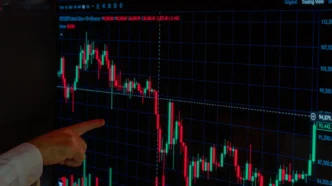

Bitcoin ETF spot demand, rather than fresh leveraged positioning, carried the bulk of BTC’s advance from $63,500 to above $80,000, according to QCP Capital’s analysis published on 28 August 2026. Futures data and ETF flow figures support the reading, even as a single-session reversal now puts that thesis under scrutiny.
Leverage Fell While Prices Rose
BTC-denominated futures open interest dropped from roughly 646,000 BTC in mid-August to 588,000 BTC as prices climbed, a pattern consistent with short covering rather than new speculative long exposure. QCP noted that funding rates stayed contained throughout, adding weight to its conclusion that ‘short covering and spot demand have played a larger role than fresh leveraged longs chasing the move.’
That structure is categorically different from a leverage-fuelled run. Rising OI alongside rising prices concentrates liquidation risk; falling OI during a price advance typically indicates net position closure, with some of that closure coming from short sellers buying to exit.
U.S. spot Bitcoin ETFs drew roughly $2.8 billion across eight consecutive inflow sessions during the rally, per QCP’s assessment. The week ending 21 August alone saw about $1.92 billion in net inflows, the strongest weekly intake since October 2025 according to data cited in earlier crypto.news coverage.
Bitcoin ETF Spot Demand Faces Its First Test
The inflow streak ended on 28 August. U.S. spot Bitcoin ETFs recorded $201.9 million in net outflows that session, a $444.2 million swing from the prior day’s $242.3 million inflow. ARK 21Shares’ ARKB led withdrawals at $114.9 million. Bitwise’s BITB shed $49.7 million, BlackRock’s IBIT lost $33.4 million, and VanEck’s HODL posted $13.2 million in outflows, according to data cited by crypto.news.
The funds still collected approximately $924.5 million across the 24–28 August trading week. One outflow session does not establish a sustained institutional exit, but Bitcoin had already slipped to near $77,500 by 29 August after a failed attempt to hold above $80,000.
Macro Headwinds: PCE, the Fed, and Treasury Buybacks
The inflation backdrop gives the Federal Reserve little room. The Bureau of Economic Analysis reported that headline PCE reached 3.7% year on year in July, with core PCE at 3.3%, both 0.2% above June. Both remain above the Fed’s 2% target. Separately, disposable personal income rose $125.9 billion (0.5%) in July, and the personal saving rate stood at 3.0% of disposable personal income.
Since then, Trading Economics, citing BEA data, reports that August 2026 headline PCE came in at 3.4% year on year, below the 3.7% July reading, with core PCE easing to 3.0% from July’s 3.3%. The cooler August print offers marginal relief, but both headline and core remain well above target.
Fed Chair Kevin Warsh reinforced the hawkish tone at Jackson Hole on 28 August, stating that the Fed’s ‘predominant focus right now should be on prices’ and observing that financial conditions were difficult to characterise as restrictive. QCP estimated that markets had priced in roughly a 35% probability of a 25-basis-point September rate increase before Warsh spoke. That figure is a market-derived probability estimate, not a Fed commitment.
The separate Treasury liquidity operation has drawn attention as a potential macro tailwind. On 19 August 2026, the U.S. Treasury announced it would double long-end liquidity-support buybacks to a floor of at least $4 billion per operation beginning 9 September, covering 10-to-20-year and 20-to-30-year nominal coupon sectors through 4 November. The announcement preceded the Bitcoin rally by roughly nine days.
The Treasury’s stated rationale was to ‘provide greater liquidity support in longer-dated nominal sectors where there is consistent strong sponsorship from market participants,’ not to stimulate risk assets. The Treasury’s tentative buyback schedule lists the 20-to-30-year maximum as ‘$0 = or > $4 billion,’ confirming the open-ended floor. The programme does not create central-bank reserves and is not quantitative easing.
Speaking to CNBC on 20 August, Treasury Secretary Scott Bessent added that operations ‘could be more than the 4 billion per issue,’ a comment that briefly eased long-end yields. The 30-year Treasury yield was trading around 5.235% at the time, near levels not seen since before the 2008 financial crisis, pressured by ballooning U.S. debt, AI-related corporate issuance, rising Japanese sovereign yields, and elevated term premiums.
For Bitcoin, the next few sessions are binary. Renewed ETF inflows alongside contained funding would confirm QCP’s spot-driven thesis. Continued outflows, particularly from IBIT given BlackRock’s scale, would indicate the institutional bid is fading faster than the leverage data alone suggests.