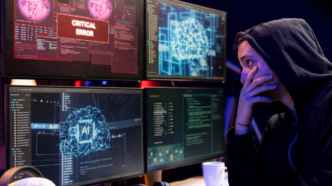

When something goes horribly, irreversibly wrong at a tech company, there is a certain silence. The kind of silence that permeates a Slack channel when someone types words that no one wants to see, not the quiet of a server room late at night. On April 1, 2026, Anthropic, a San Francisco-based AI company that has spent years carefully establishing a reputation as the responsible adult in an increasingly careless industry, unintentionally gave the world a comprehensive roadmap to its most important product. The entire 512,000 lines.
About 1,900 files and 512,000 lines of code connected to Claude Code, an agentic coding tool that operates directly inside developer environments, were compromised by the unintentional release. It’s not a small configuration file that was left on a public server. For years, rival engineers, venture capitalists, and nation-state actors have been attempting to reverse-engineer that product’s intellectual core. The fact that Anthropic characterized it as “a release packaging issue caused by human error” almost exacerbates the situation. No complex assault. There is no zero-day exploit. Just an error. An extremely costly and significant error.
Anthropic PBC
| Founded | 2021 |
| Founders | Dario Amodei, Daniela Amodei & others (ex-OpenAI) |
| CEO | Dario Amodei |
| Flagship Product | Claude AI (claude.ai) + Claude Code |
| Valuation | ~$61.5 Billion (2025) |
| Key Investors | Google, Amazon, Spark Capital |
| Incident Date | April 1, 2026 (Claude Code Source Leak) |
| Code Exposed | ~1,900 files · 512,000 lines |
| US Gov. Status | Declared supply chain risk (contested in court) |
| Official Website | anthropic.com |
It’s difficult to ignore the fact that Anthropic, a company whose whole brand promise is based on the notion that AI can be developed carefully, was the target of this. It is impossible to ignore that tension. It appears that a deployment procedure used by the same organization that publishes papers about the existential dangers of artificial general intelligence could unintentionally release half a million lines of proprietary source code onto the public internet. It could be argued that these are completely different engineering issues. They might also be signs of the same underlying strain: a business that is expanding more quickly than its internal systems can manage.
The unintentional disclosure was Anthropic’s second security error in a few days. Fortune revealed last week that Anthropic had been keeping thousands of internal documents on a system that was open to the public, including a draft blog post that described an upcoming model that the company internally referred to as both “Mythos” and “Capybara.” There were two incidents in one week. It’s not unlucky. That’s a pattern, or at least the start of one. Additionally, patterns are crucial in a field where trust is essentially the product.
A post on the social media site X that received over 30 million views initially revealed the most recent unintentional release involving Claude Code. Thousands of people posted on the internet after the leak, claiming to have examined the code and discovered both peculiarities in the current Claude Code system and features that have not yet been released. The story had eluded any chance of quiet containment in a matter of hours. It turns out that the internet is remarkably effective at disseminating content that shouldn’t be.
Here, the security implications are practical and particular rather than hypothetical. Attackers can now precisely examine how data moves through Claude Code’s four-stage context management pipeline and create payloads that are made to withstand compaction, thereby maintaining a backdoor for an arbitrarily long session, according to a warning from AI cybersecurity firm Straiker. It’s worth taking a moment to consider that technical issue. It goes beyond simply replicating Anthropic’s assignments. Knowing exactly where the walls are thin is crucial.
The disclosures couldn’t come at a worse time for Anthropic, which has warned that the labeling could cost it billions of dollars in lost revenue. The U.S. government designated Anthropic as a supply chain risk earlier this year, and the company is contesting the designation in court. Thus, the company is unintentionally confirming that its internal engineering processes have some significant gaps while simultaneously defending itself in a legal dispute regarding whether it poses a national security risk. PR teams create crisis playbooks based on this type of timing.
Beneath all the technical details, there’s a bigger question as we watch this develop: what does it mean for the global AI security landscape when the companies we rely on to create strong systems are unable to reliably protect their own source code? In this regard, Anthropic is not unique. Engineering culture finds it difficult to keep up with the industry’s rapid growth. However, Anthropic holds a particular symbolic place. It was meant to be different. thoughtful and deliberate.
The industry as a whole believes that this incident will hasten a more serious discussion about software supply chain security in AI development, which has been quietly developing. The operational kind, not the abstract one found in policy white papers. Who examines the contents of a release? How does a file with internal source paths find its way into a public distribution? These are not glamorous inquiries. However, they are the most important at this moment because the answer to the question “how did this happen” is ultimately “nobody caught it in time.”
The code has been observed. Whatever was contained in those 512,000 lines—clever engineering, hints about upcoming products, architectural choices rivals would pay real money to comprehend—is now irreversibly part of the public record. According to Anthropic, no private client information was compromised. That has some value. However, the discussion of what AI safety actually entails on an operational, daily basis in a shipping environment under commercial pressure has become much more complex.