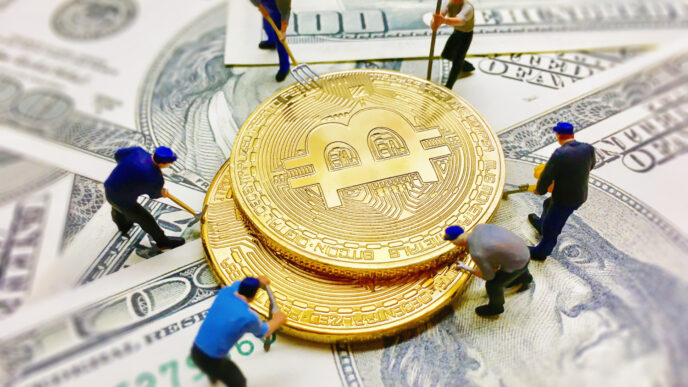

For many years, the comparison of Bitcoin to gold sounded more like a handy metaphor than a legitimate financial assertion; it was repeated frequently enough to stick but seldom put to the test under persistent pressure. But in recent years, capital behavior has started to resemble the analogy in ways that feel remarkably similar to how gold gained its reputation over centuries.
Scarcity, durability, and independence from political systems have always been the main draws of gold. These same ideas underpinned the creation of Bitcoin, which was expressed digitally as opposed to physically. Its supply is not only restricted, but also finite, with a cap of 21 million coins. This restriction is very obvious and is enforced by software rather than verbal agreements.
| Aspect | Details |
|---|---|
| Core Topic | Bitcoin as a modern store of value |
| Primary Comparison | Bitcoin versus physical gold |
| Supply Structure | Fixed cap of 21 million coins |
| Key Use Case | Hedge against fiat debasement |
| Adoption Drivers | Institutions, corporations, sovereign behavior |
| Network Security | Decentralized proof-of-work |
| Reference | https://bitcoin.org |
Bitcoin is issued according to a clear schedule, in contrast to gold, whose yearly supply fluctuates as new deposits are found or mining technology advances. New supply is cut in half every four years; this procedure is well known and confirmed by anyone in charge of the network. Investors who are concerned about silent dilution will especially benefit from that predictability.
As governments normalize deficit spending, this coded scarcity has become more significant. Major economies now have structural debt instead of cyclical debt, and central banks are depending more and more on monetary expansion to keep growth stable. This strategy gradually reduces purchasing power and silently taxes savers who continue to be fully exposed to fiat currencies.
The central banks’ renewed gold holdings are telling in that regard. Official institutions validate the reasoning behind holding “outside money” when they turn to assets that are not part of credit systems. That category includes Bitcoin, which provides a digital alternative to the long-standing function of gold.
Businesses have begun to adopt this way of thinking. Because it reframed Bitcoin as a balance-sheet asset rather than a speculative trade, MicroStrategy’s decision to make Bitcoin the focal point of its treasury strategy marked a turning point—not because of publicity. Since then, other people have been motivated to investigate comparable allocations.
Adoption by institutions has ensued. For conventional investors, spot Bitcoin exchange-traded funds have greatly lowered barriers by providing exposure without the hassle of custody. Bitcoin is now more securely anchored within traditional portfolios thanks to this integration, which has significantly increased liquidity and legitimacy.
Bitcoin has advantages over gold that are difficult to match due to its digital nature. Cross-border gold transportation is costly, time-consuming, and frequently subject to regulations. Bitcoin settles peer-to-peer without middlemen and moves at internet speed. Particularly in times of geopolitical strain, portability is more important for a store of value than romance.
Bitcoin’s case is further strengthened by its divisible nature. Gold is not practical for smaller units of account because it can only be divided with effort and loss. Bitcoin, on the other hand, allows for precise value transfer without degradation because it is divisible into 100 millionths of a unit. Because of this, it can be used as a fine-grained settlement layer as well as a sizable reserve asset.
Another parallel that is frequently overlooked is security. Gold depends on custodians, vaults, and guards. Bitcoin is based on a decentralized consensus that is protected by cryptography and energy. Without the need for institutional middlemen, ownership and transfer are remarkably transparent due to its immutable and publicly verifiable ledger.
Bitcoin’s lack of gold’s physical presence and industrial use is a common criticism. However, the value of gold has never been reliant on jewelry or electronics. Its value came from shared trust and scarcity. These foundations are replicated digitally by Bitcoin, which replaces physical permanence with mathematical certainty.
Bitcoin appears to be maturing based on market behavior. Even though it has frequently traded like a riskier asset, there have been recent instances where it has decoupled from stocks, especially during uncertain monetary times. A few cycles ago, this change would have seemed unthinkable, but analysts have noticed that Bitcoin is now acting more like a risk-off asset.
Comparisons of short-term performance may mask this evolution. Due to aggressive central bank purchases and macro anxiety, gold surpassed Bitcoin in 2025. Rather than a failure of Bitcoin’s thesis, that divergence is a reflection of gold’s firmly established institutional role. Bitcoin is barely old enough to operate a vehicle, whereas gold has millennia of credibility.
One important factor in the development of trust is time. History and statecraft are intertwined with Gold’s story. The history of Bitcoin is still being written, influenced by infrastructure, regulation, and adoption. But even in times of volatility, its fundamental characteristics hold steady, boosting long-term holders‘ confidence.
This shift has been accelerated by cultural cues. More and more well-known investors and public personalities present Bitcoin as a hedge rather than a risk. Perception changes from speculative interest to strategic consideration when asset managers bring up Bitcoin in conversation with gold.
Macroeconomically speaking, as real yields decline, Bitcoin’s appeal grows. Scarce assets become important when bonds are unable to prevent the erosion of cash guarantees and purchasing power. In the past, Gold has performed that function. These days, Bitcoin vies for the same share, especially with investors who are digital natives.
Through hardware and energy consumption, the network’s proof-of-work architecture grounds Bitcoin in reality. Although this feature is frequently criticized, it offers a very solid security basis that makes attacks unaffordable and strengthens Bitcoin’s resistance to manipulation.
From a philosophical standpoint, Bitcoin lessens reliance on trust. Ownership of gold frequently necessitates borders, vaults, and middlemen. Direct ownership is made possible by Bitcoin, which is protected by private keys as opposed to institutions. In unstable political environments, that autonomy is truly valuable.
There is still skepticism, particularly if Bitcoin declines in value in tandem with stocks. Rather than refuting its function, these instances emphasize how it is changing. Before solidifying its position as a store of value, even gold went through protracted periods of volatility.
Crucially, Bitcoin does not have to take the place of gold in order to support the story. Coexistence is adequate. The market capitalization of Bitcoin is still small compared to that of gold, indicating significant potential growth if uptake persists. Instead of directly competing with gold, its digital attributes enhance its physical ones.
The rise of Bitcoin is indicative of a larger societal reevaluation of trust. People and organizations are looking more and more for assets that function outside of political cycles as debt mounts and institutions become overburdened. That choice is provided by Bitcoin in a format that is compatible with digital life.
Behavior, not ideology, is what makes the “digital gold” narrative so appealing today. Bitcoin is increasingly viewed as a store of value rather than a speculative novelty by institutional frameworks, capital flows, and balance-sheet decisions.
Through centuries of survival and trial and error, gold earned its place. Bitcoin, which is driven by code rather than custom, is condensing that process into decades. The analogy seems less like a metaphor and more like a description as adoption grows and monetary pressures continue, indicating that the story of Bitcoin as “digital gold” may finally be coming to terms with reality.