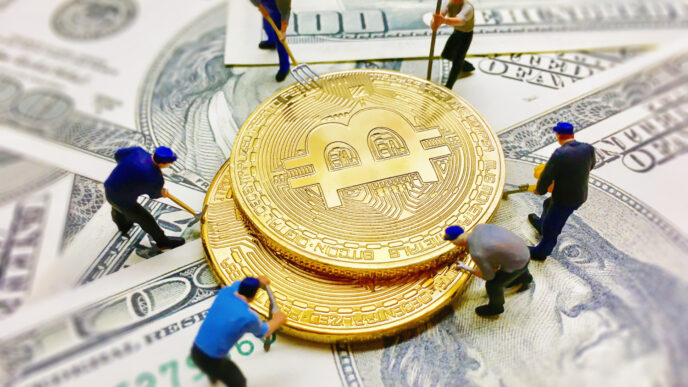
It no longer seems as though decentralized finance is a side project operating in the background of markets. When software, rather than institutions, does the heavy lifting, it has become a visible, contested force that is changing presumptions about who controls financial rails and how trust is established.
DeFi’s initial promise was simple but revolutionary. In the same way that a swarm of bees organizes complex behavior without a central command, financial services could be rebuilt as open protocols that operate continuously and transparently. Discretion would be replaced by code, and access would be independent of status or location.
| Aspect | Details |
|---|---|
| Topic Focus | Decentralized Finance (DeFi) |
| Core Purpose | Replacing intermediaries with smart contracts |
| Key Technologies | Blockchain, smart contracts, tokens |
| Main Benefits | Open access, self-custody, instant settlement |
| Central Tension | Innovation versus regulation |
| Reference | https://ethereum.org |
That concept was incredibly successful in luring talent and money. DeFi protocols evolved from specialized tools used by developers to systems handling tens of billions of dollars in less than ten years. Marketing was not the only factor driving this expansion; utilities that resembled banks, exchanges, and insurers but lacked the manual friction layers were also a major factor.
Attention followed the rise in volume. The replication of lending, trading, and settlement in parallel systems that never closed, cleared instantly, and required no permission to join was noticed by traditional financial institutions. This was a challenge to economic gravity rather than just competition for incumbents used to fee-rich intermediated structures.
The emergence of tokenized stocks increased the tension. The function of market makers, brokers, and clearinghouses is questioned when shares of publicly traded companies can trade on blockchains 24/7. Strong arguments have been made by companies like Citadel Securities that such systems run the risk of weakening investor protections and fragmenting liquidity.
These cautions are not purely theoretical. Inadequately designed protocols can expose users to losses, and fragmented markets can raise costs. However, detractors frequently ignore the similar growth pains that traditional finance underwent, with regulation often trailing rather than leading innovation.
Venture capital firms, developers, and crypto-native platforms—including Andreessen Horowitz and protocols like Uniswap—are on the opposing side of the argument. Their claim is straightforward and unwavering: decentralized exchanges already handle billions of transactions every day with remarkably transparent transparency while lowering dependency on opaque middlemen.
A deeper disagreement regarding regulation itself is revealed by this conflict. Should policy change to reflect architectures that are fundamentally different, or should new systems be pushed into legacy frameworks? The response is significant because it will determine whether DeFi stays on the margins or integrates into the mainstream of capital flows.
DeFi’s underlying technology has rapidly advanced. Programmable finance was made possible by Ethereum’s smart contracts, which allowed for the direct encoding of loans, derivatives, and governance into software. Interest rates could be set algorithmically, reacting instantly to supply and demand instead of committee decisions, as shown by protocols like Compound.
Such automation eliminates delays and lowers expenses and is very effective. Moreover, it is unforgiving. Losses are instantaneous and frequently irreversible when code fails. Concerns that risk had not vanished but had instead moved from institutions to users were reaffirmed by well-publicized exploits.
The ecosystem adjusted as a result. The emergence of insurance protocols such as Nexus Mutual provided protection against smart-contract failures by means of transparent regulations and pooled capital. This strategy is especially creative since it removes layers of administrative burden while reviving the fundamentals of mutual insurance.
Another battlefield has been the user experience. Early DeFi tools were challenging to use and best suited for specialists who were at ease with intricacy. Wallets like MetaMask have significantly enhanced their user interfaces over time, serving as gateways rather than obstacles and making participation surprisingly inexpensive from a cognitive standpoint.
This development is similar to past changes in technology. Before browsers made the internet accessible, users had to use cryptic commands to access it. DeFi seems to be taking a very similar route, maintaining decentralization at its core while sacrificing raw power for usability.
Scalability and speed are now key considerations. Ethereum’s congestion made room for rivals like Solana and Avalanche, which offer cheaper prices and quicker execution. For financial applications where delays directly result in risk, Avalanche’s near-instant finality is especially advantageous.
The ecosystem is breaking up into specialized networks connected by bridges rather than coming together on a single chain. Because of its highly adaptable modular design, protocols can share liquidity across systems and optimize for various needs.
The most obvious manifestation of DeFi’s goals is still trading. Despite not having corporate headquarters or customer service desks, decentralized exchanges are now on par with centralized platforms in terms of volume. Formulas were used in place of traditional order books by automated market makers, which decreased friction but also created new types of volatility.
A practical solution is the emergence of hybrid models. Certain platforms combine decentralized settlement with centralized compliance and speed, recognizing that users value autonomy while institutions require certainty. This convergence raises the possibility that the future will be multilayered rather than binary.
Though cautiously, institutional interest is still growing. Exchanges look for legitimacy through licensing and communication with regulators, as demonstrated by events like Bybit’s institutional gatherings in Abu Dhabi. Once thought to be incompatible with decentralization, compliance is now presented as infrastructure rather than a limitation.
Large allocators’ trust has significantly increased as a result of this change. Uncertainty is reduced by predictable regulations, allowing asset managers and pension funds to participate without violating mandates. In this way, regulation stops being a barrier and instead acts as a bridge.
Celebrities and public figures have drawn more attention, which can occasionally skew perception. While scandals stoked skepticism, endorsements increased visibility. Beneath the commotion, however, progress proceeded steadily, driven more by practicality than by sentiment.
It is difficult to overlook the societal ramifications. DeFi provides gatekeeper-free access to savings, credit, and international markets in areas underserved by traditional banking. For many users, these tools are useful remedies to exclusion, capital controls, and inflation rather than ideological declarations.
Regulators must perform a careful balancing act. While permissive approaches may put unsophisticated users at risk, overly restrictive policies run the risk of pushing innovation offshore. As authorities try to comprehend systems that are changing at the speed of software, the current regulatory frenzy is more a reflection of uncertainty than animosity.
In the end, trust and power are key factors in the struggle for the future of decentralized finance. Who establishes the guidelines for trade? From capital movement, who receives fees? And when systems malfunction, who is at fault? By suggesting that coordination can arise from open code rather than centralized authority, DeFi challenges conventional wisdom.
Persistence is what feels different now. DeFi continues to draw investors and builders despite economic downturns, abuses, and political pressure. This resilience points to a structural change rather than a period of speculation, indicating a more open, programmable, and participation-driven financial environment rather than one that is shaped by consent.