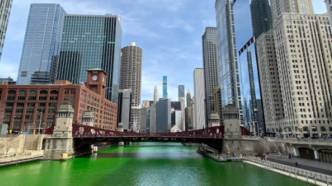
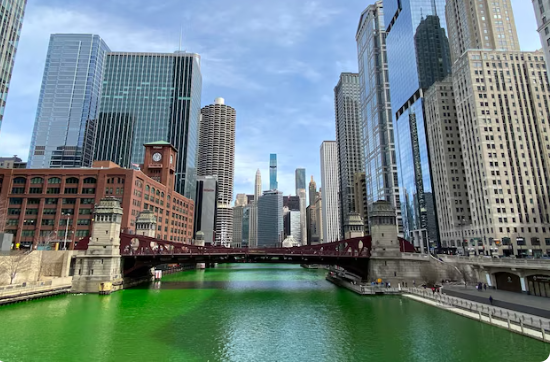
Just before the dye reaches the water, the Chicago River appears as it always does: muted, slightly industrial, with reflections of glass towers and steel bridges. Then, almost without warning, it doesn’t.
Just after ten in the morning on a chilly March day in 2026, a small fleet of boats assembled close to Michigan Avenue. Leaning over the edges, workers in yellow jackets poured a powder that appeared almost orange against the gray water. The river started to change in a matter of minutes, blossoming into an almost unbelievable shade of green. Not delicate. Not organic. Something more theatrical. It’s the Chicago Green River, and it has been going on for 64 years.
Key Information About the Chicago Green River Tradition
| Category | Details |
|---|---|
| Event | Annual Chicago River Dyeing |
| Occasion | St. Patrick’s Day |
| First Year | 1962 |
| Organized By | Journeymen Plumbers Local Union |
| Dye Type | Vegetable-based (proprietary blend) |
| Duration of Color | ~5 hours |
| Location | Downtown Chicago (Michigan & Wacker area) |
| River Length | 156 miles (entire system) |
| Notable Fact | Flow of river reversed in 1900 |
| Official Reference | https://www.chicago.gov |
With coffee cups in hand and green scarves that felt a little too thin for the wind coming off Lake Michigan, crowds line the bridges early, some arriving before sunrise. Children are lifted onto shoulders by families. In anticipation of the moment when the hue shift becomes evident, tourists hold their phones steadily. Even among those who have seen it before, there is a growing sense of quiet anticipation.
When the water turns, it’s difficult to ignore how rapidly the atmosphere shifts. Individuals lean forward, grinning in a manner that seems less practiced than anticipated. The river, which typically disappears into the background of the city, suddenly takes center stage.
On the surface, the procedure is surprisingly easy. The process is run by about 130 members of the Journeymen Plumbers Local Union, who use hoses attached on boats to disperse about 40 pounds of dye. Although the precise recipe is still kept under wraps, it is thought to be vegetable-based and safe for the environment.
The ceremony seems to gain something from that concealment. It’s more than just the hue; it’s the enigma of how it’s done, why it continues to function, and why nobody outside the union truly understands the specifics.
Almost by mistake, the tradition started in 1962. Union business manager Stephen Bailey saw that the dye used to find plumbing problems turned water a bright green. Though it undoubtedly didn’t seem that way at the time, the transition from industrial tool to public spectacle seems almost inevitable in retrospect. That origin narrative has a very Chicago feel to it. Useful, a little makeshift, and surprisingly durable.
The celebration seems nearly at odds with the river’s much older history. It is 156 kilometers long and has been literally formed by human activity through a system of branches and canals. Engineers altered its flow in 1900, directing water toward the Mississippi River basin and away from Lake Michigan. Driven by worries about public health, it was a daring, almost arrogant step. It’s simple to overlook that intricacy while standing on a bridge during the dying process. It is concealed by the green surface. Or perhaps it makes it softer.
The color progressively fades throughout the course of the day, lasting just roughly five hours. The river starts to revert to its typical tone by late afternoon, with the green fading into a less striking hue. It’s a transient change, which may contribute to its allure. There is a feeling that the event’s transient ness adds to its significance. The river would lose its uniqueness and capacity for surprise if it continued to be green.
There is a discernible change as the crowd disperses later in the day. The energy calms. People proceed to clubs, parades, and other celebration venues. Once more, the river blends into the background.
The Chicago Green River is become more than just a regional custom. It has appeared in numerous social media posts, movies, and TV series. Every year, pictures of the vivid green sea surrounded by skyscrapers go viral. Although it’s not always simple to define, it’s a sign.
It seems to symbolize the city’s connection with its own past, embracing it, changing it, and occasionally masking its more difficult aspects. In a more subdued manner, it serves as a reminder of how cities use repetition to build meaning. An event is something you do once. It becomes something completely different after 64 years of doing it.
Although authorities maintain that the dye is safe, there is sporadic discussion regarding its effects on the environment. Every now and then, skepticism emerges, particularly among people who regard the river as more than just a place to celebrate. These worries might intensify over time, especially as environmental challenges become more widely recognized.
The Chicago Green River seems to reside somewhere between spectacle and ceremony as you watch things play out. It is both well-planned and a little unpredictable, recognizable but still able to attract a large audience.
Every March, the river becomes more than simply a river for a few hours. It transforms into something different—something stranger, brighter, and somehow reassuring in its consistency. Then it fades, as it always does, leaving the recollection of a city that chooses to alter the hue of its own reflection at least once a year.