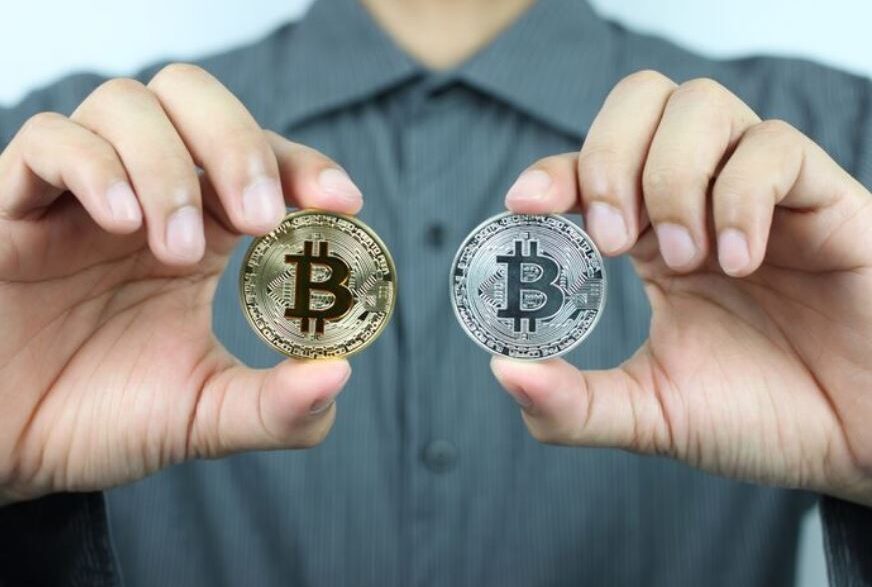
When you check the price of Bitcoin for the first time in a long time, you experience a certain kind of sticker shock. The number appears on the screen and demands to be processed when someone does it at a kitchen table or on their phone while they wait for coffee. One Bitcoin is currently trading for between $74,000 and $75,000. About $37,000 to $37,500 is the equivalent of half of that, or 0.5 BTC, which many novice investors inquire about because owning a full coin seems unachievable. That amount is not insignificant. It’s a used vehicle. In many mid-sized American cities, a year’s rent. a significant portion of a person’s savings.
However, given where that figure has been, $37,000 for half a Bitcoin is either a remarkable opportunity or a sobering reminder of how much has already happened without you, depending on your point of view. The same 0.5 BTC would have cost you roughly $2,590 in April 2019. When Bitcoin reached its peak of $111,970 in May 2025, half a coin momentarily approached $56,000 before declining. The asset’s most alluring and draining feature is that the price has never remained steady long enough to feel stable.
| Category | Details |
|---|---|
| Current Value: Half a Bitcoin (0.5 BTC) | |
| Value in USD (Apr 2026) | Approximately $37,000–$37,500 USD — based on Bitcoin trading near $74,939–$75,101 per coin as of April 16, 2026 |
| Value in PKR (Apr 2026) | Approximately 10,431,328 Pakistani Rupees — based on 1 BTC = ~20,862,656 PKR as of April 16, 2026 |
| Bitcoin’s Current Price | $74,939–$75,101 per BTC; market cap approximately $1.5 trillion; circulating supply 20.02 million out of 21 million maximum |
| Historical Context: What 0.5 BTC Cost Before | |
| 2009 (Launch) | Bitcoin had essentially no monetary value — 0.5 BTC was worth fractions of a cent; in 2010 a developer received the first 10 BTC transaction for free as a test |
| 2019 (April) | 0.5 BTC ≈ $2,590 USD — answering a Quora question from that era reveals how dramatically the baseline has shifted |
| 2021 (Peak cycle) | 0.5 BTC reached approximately $30,000–$35,000 USD during Bitcoin’s surge toward $60,000+; then fell nearly 50% within weeks |
| May 2025 (All-Time High) | Bitcoin reached an all-time high of $111,970 — meaning 0.5 BTC was worth approximately $55,985 at the peak |
| Bitcoin Fundamentals | |
| Maximum Supply | Only 21 million Bitcoin will ever exist — by design; approximately 20.02 million are already in circulation as of April 2026 |
| Divisibility | 1 Bitcoin = 100,000,000 satoshis; users can buy any fraction — 0.5 BTC, 0.01 BTC, or even $10 worth — through most major exchanges |
| Last Halving | April 2024 — block reward cut to 3.125 BTC per block; next halving expected approximately 2028, further reducing new supply |
| Live Price Tracking | Current BTC/USD rates available at CoinDesk’s Bitcoin price page — updated in real-time with 24-hour volume and market cap data |
| Buying 0.5 BTC: Practical Context | |
| Can You Buy Half a Bitcoin? | Yes — all major exchanges including Coinbase, Binance, and Kraken allow fractional purchases; no requirement to buy a whole coin |
| Comparison to Other Assets | 0.5 BTC at ~$37,000 is roughly equivalent to: a mid-range new car, one year of average US household expenses, or 37 troy ounces of gold at current gold prices |
How much half a Bitcoin is worth seems like a straightforward question. Really, it isn’t. The response varies minute by minute and is monitored in real time across dozens of exchanges, each of which displays slightly different numbers based on geography and trading volume. Binance, Coinbase, and Kraken all show real-time prices that move within a range, and the difference between them at any given time can be several hundred dollars.
When someone in Pakistan asks the same question, the response is given in Pakistani rupees, which is currently approximately 10.4 million PKR for 0.5 BTC, based on a full Bitcoin price of roughly 20.8 million rupees. The math is the same everywhere, but the number’s emotional significance varies greatly depending on the situation.
Understanding why it moves the way it does is more important than the precise dollar amount since it establishes whether the current price is safe or risky. About 20 million of the 21 million coins that make up Bitcoin’s hard cap are currently in use. Less than 1 million coins remain to be mined over the ensuing decades, and the rate at which new coins enter the supply decreases with each halving event, the most recent of which took place in April 2024 and reduced miner rewards to 3.125 BTC per block. According to basic economics, prices rise when there is a fixed supply and rising demand. With a few notable exceptions, Bitcoin’s history mostly supports that theory. The Brookings Institution pointed out bluntly that after reaching over $60,000 at one point, Bitcoin’s value dropped to half of that amount in a matter of weeks. In this market, that kind of movement is not unusual. It is the initial state.
In the current cycle, the notion of owning half of a Bitcoin has gained significant psychological weight. It felt modest to discuss owning 0.5 BTC when the price of Bitcoin was only a few thousand dollars. There is a growing community of people who treat 0.5 BTC as a specific target, not full ownership, which requires a six-figure outlay that most households cannot absorb, but a meaningful stake that still participates in whatever direction the asset moves next. Currently, it is at the threshold of what many retail investors can realistically afford after saving meaningfully. Reading the commentary from investors who have been accumulating since Bitcoin’s earlier cycles gives the impression that a sizable portion of the market is aiming for half a coin—enough to matter, feasible enough to pursue.
The fact that you don’t have to purchase all of Bitcoin at once is a relief for new purchasers. Fractional purchases are permitted on all major exchanges, including Coinbase, Binance, and Kraken. You can purchase $50 worth. You can purchase $500 worth. You can gradually build up to 0.5 BTC over months or years by setting up weekly recurring purchases of whatever you can afford. Because Bitcoin can be divided into satoshi, or 100 millionths of a coin, the entry point is actually as low as you want it to be. The 0.5 target is both a mathematical convenience and a cultural marker; more ardent Bitcoin investors typically view it as a benchmark that should be met before supply dynamics drive the price farther out of reach.
It’s genuinely unclear if that framing will endure over the coming years. In May 2025, Bitcoin hit $111,970. Since then, it has retreated to the mid-$70,000 range, posing the question that always arises after a decline from an all-time high: is this a consolidation prior to the next move, or is this the start of a longer correction? Depending on how they interpret macro conditions, analysts observing exchange flows, ETF inflows, and the Fear and Greed Index provide varying responses. The fact that 0.5 BTC today, at about $37,000, represents an asset that was worth fifty dollars ten years ago and reached $56,000 as recently as last year, is undeniable. The current moment in an unfinished story is represented by the number on the screen.